When to Ask Your Yoga Teacher for a Different Option
Learn when to request a pose variation, how to communicate with your instructor, and how to modify safely.
https://primetempr.com/blog/when-to-ask-your-yoga-teacher-for-a-different-option
You should ask a yoga teacher for another option whenever a pose feels painful, inaccessible, or causes a sense of "stuckness" that prevents you from breathing naturally. Many students feel they must push through discomfort to do the practice "correctly," but the most effective practice is one that respects your body’s current limits. Asking for a variation is not a sign of weakness or a lack of skill; it is a proactive tool for sustainable, safe, and personalized movement.
In a group setting, it is easy to feel like you are disrupting the flow or that you are the only one struggling. However, yoga is a combination of postures, breathing, and meditation where styles vary significantly, and injuries can occur if the physical demands exceed your current capacity. Prioritizing your safety over the "standard" version of a pose is a fundamental part of a mature practice.
Why Asking for Options is Part of the Practice
The goal of yoga is not achieving a specific aesthetic shape, but engaging in movement that supports your well-being. According to the World Health Organization, any amount of physical activity is better than none, and all activity counts toward your health. If a specific pose, such as a deep lunging twist or a full plank, feels impossible or dangerous today, modifying that pose ensures you stay active rather than stopping entirely.
Yoga styles vary widely, ranging from restorative practices to high intensity power flows. Because of this variety, the benefits of any specific pose should be described with uncertainty; what works for one person’s hip structure may cause impingement for another. When you ask for an alternative, you help the teacher do their job by guiding you toward a version of the practice that is actually beneficial for you.
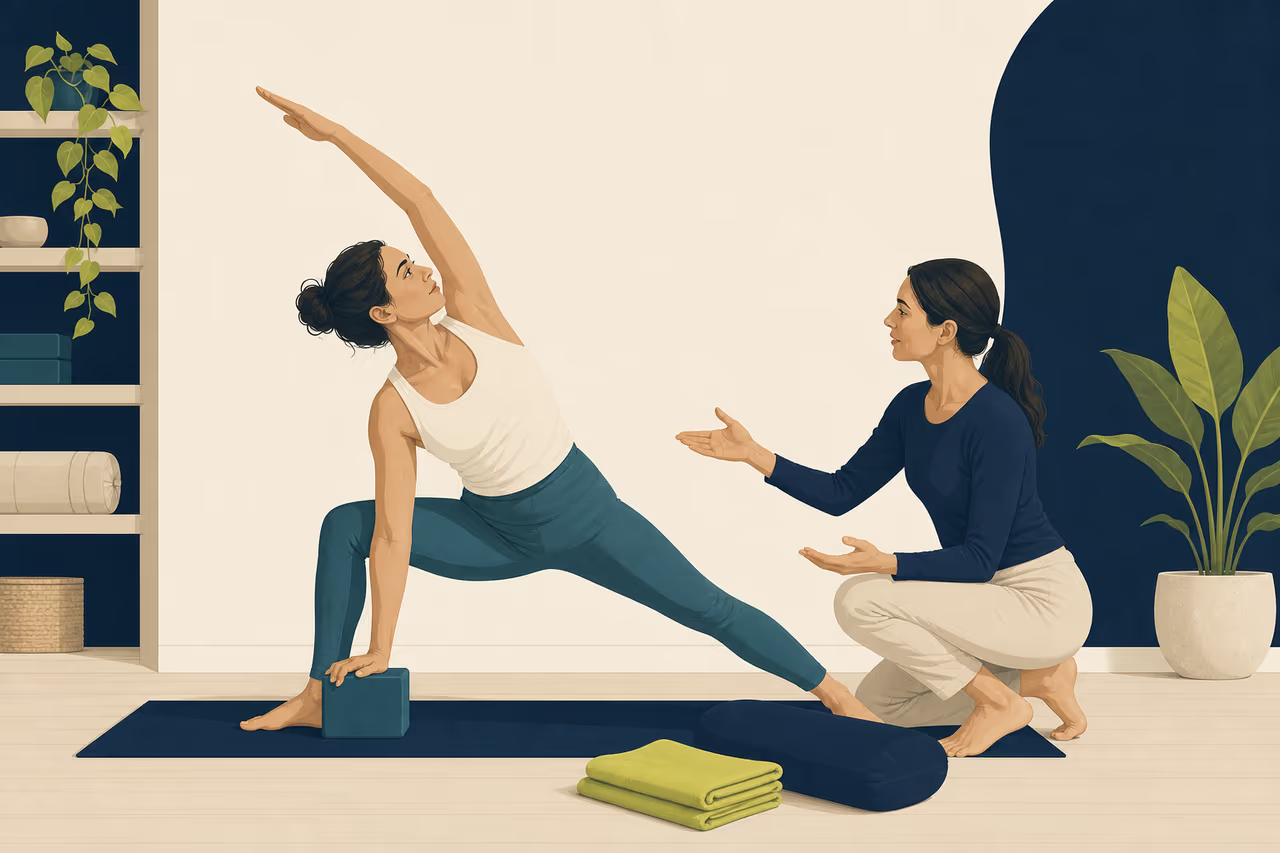
Identifying When You Need a Variation
Distinguishing between a "productive challenge" and an "unsafe sensation" is a skill that takes time to develop. You can use the following table to help decide when it is time to signal your teacher for an alternative.
| Sensation Type | What it Feels Like | Action to Take |
|---|---|---|
| Productive Challenge | Muscle fatigue, "heat," or a dull, broad stretch. | Continue with focus; maintain steady breath. |
| Unsafe Sensation | Sharp, shooting, or electric pain; pinching in a joint. | Stop immediately; ask for an alternative. |
| Inaccessibility | Your limbs physically cannot reach the floor or a prop. | Use a block or ask for a modified height/shape. |
| Breath Restriction | Feeling like you have to gasp or hold your breath. | Back out of the pose until breath is steady. |
If you are unsure how to interpret what you are feeling, you may find it helpful to read more on how to interpret sensation language in yoga class.
How to Communicate with Your Teacher
You do not need to wait for a formal break in the class to seek help. Most teachers prefer that you ask for a modification rather than risk an injury. Here are three low friction ways to communicate:
- The Non-Verbal Signal: If the teacher is walking around the room, make eye contact and point to the joint or area that feels uncomfortable. Often, a teacher will recognize this as a request for a prop or a manual adjustment (if you have consented to touch).
- The Brief Question: During a transition, you can use a simple script: "Could you show me a variation for this pose that is easier on my shoulder?" or "Is there a way to do this without putting weight on my wrists?"
- The Default Pose: If the class is moving too quickly to ask a question, move into a "neutral" pose like Child’s Pose or Mountain Pose. This signals to the teacher that you are taking a break, and they will often come over to offer a suggestion without you having to say a word.
The Trade-offs of Asking for Options
Be sure to acknowledge the practical trade-offs involved in modifying your practice. Asking for options may briefly pause your flow or take you out of the "rhythm" of the music or the group. Additionally, a variation might feel different than the "standard" pose, which is expected. You might feel less "intense" work in one area but more stability in another. Not every teacher will have the same approach to modifications; some may have a dozen options ready, while others may only suggest resting. Both are valid responses, but they require you to be the final judge of what is right for your body.
Before Your Next Class: A Pre-Practice Check-in
Use this checklist to prepare yourself for a more personalized experience in your next session.
- Identify one area of your body that feels tight or sensitive today. (e.g., "My lower back feels a bit stiff from sitting all day.")
- Decide on a 'neutral' pose you can return to. If a sequence feels unsafe or confusing, know that you will automatically go to Child’s Pose or sit cross-legged.
- Prepare a simple, direct question. Having a script like, "Can we find an alternative for [Pose]?" reduces the anxiety of speaking up mid-class.
- Remind yourself of the goal. Your goal is movement and breath, not performing a specific shape to match the person next to you.
Turning Unfamiliar Language into Better Questions
One of the biggest barriers to asking for help is not knowing the "right" words. Yoga terminology can be confusing, and if you don't know that "Adho Mukha Svanasana" means Downward-Facing Dog, you might feel too intimidated to ask for a modification.
Prime Tempr's trainer marketplace lets readers turn unfamiliar yoga language into better questions. Instead of relying on a static glossary alone, you can practise with a qualified trainer who can explain the "why" behind the movement. When you choose guided instruction, you move from guessing what a pose should feel like to having a conversation about what it does feel like. This personalized feedback loop is often the fastest way to understand why yoga teachers offer pose options and how to choose the one that fits your mobility.
When to Seek a Different Environment
If you consistently find yourself in pain or feeling ignored when you ask for help, it may be time to find a different class or teacher. A teacher’s primary responsibility is the safety of the students. If a teacher is unreceptive to questions, tells you to "push through the pain," or dismisses your request for a variation, they may not be the right fit for your current needs.
Prioritizing your own safety is not "quitting." It is an act of body literacy. If an environment doesn't feel supportive, you have the right to rest or choose a different studio where modifications are celebrated rather than tolerated.
FAQ: Navigating Class Options
Is it okay to change a pose if it feels painful? Yes. Pain is a signal from your nervous system that something is wrong. Continuing to push through sharp or pinching pain increases the risk of injury.
What if the teacher doesn't offer options? If a teacher doesn't proactively offer variations, you can still take them. Use props, stay in a previous version of the pose, or move to a resting position. You are always the ultimate authority on your own body.
How can I tell if a variation is right for my body? A "right" variation allows you to maintain a steady, even breath and feel the intended work (like muscle engagement) without joint pain or strain.
When is it better to find a different class? If the pace is consistently too fast for you to move safely, or if the teacher’s style focuses on "perfection" over personal adaptation, seeking a more accessible or mobility-focused class may be more beneficial.
Sources
- Yoga: Effectiveness and Safety | https://www.nccih.nih.gov/health/yoga-effectiveness-and-safety (opens in a new tab)
- Physical activity | https://www.who.int/news-room/fact-sheets/detail/physical-activity (opens in a new tab)
Watch alongside this guide
An introductory yoga flow
Watch how spoken cues, breath, and transitions work together, then compare them with the article's guidance. Source: Yoga With Adriene. This optional video is context, not evidence or personal instruction.
The YouTube player stays unloaded until you choose to watch. Loading it connects to YouTube and may allow that service to process usage data.