Why Your Overhead Movement Feels Stuck (And What to Do Next)
Discover why overhead movement can feel restricted and learn how balancing mobility with stability addresses the root cause.
https://primetempr.com/blog/why-your-overhead-movement-feels-stuck-and-what-to-do-next
If you feel restricted or unsure when reaching your arms overhead, your first instinct might be to stretch more. However, "tightness" is often a signal that your body is protecting itself due to a lack of stability, rather than a simple lack of flexibility. Overhead movement is a complex interaction involving your shoulders, thoracic spine, ribcage, and core. When these elements aren't working in concert, your range of motion will naturally feel limited.
Understanding the interplay between mobility and stability is the first step toward moving with more ease. While muscle strengthening and physical activity are beneficial for all adults and contribute to overall movement capacity, generic routines often fail to address the specific compensatory patterns you may have developed.
Defining the overhead challenge
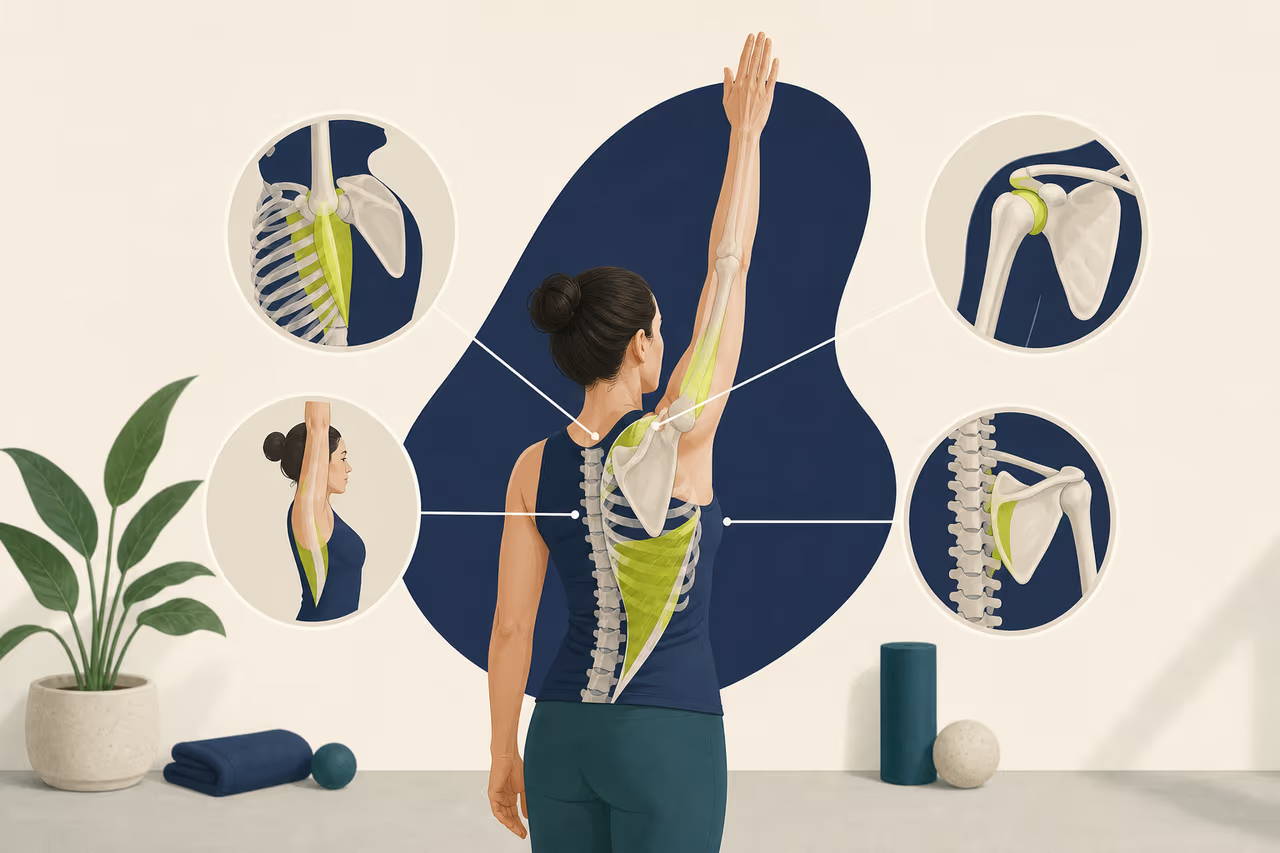
Reaching overhead is not just a shoulder action. It requires a synchronized effort from several parts of the body. When you raise your arms, your shoulder blades (scapulae) must rotate and tilt, your thoracic spine (upper back) must extend, and your core must provide a stable base to prevent your lower back from arching excessively.
If one of these components is restricted or lacks the necessary strength to control the movement, your brain may limit your range of motion to prevent potential strain. This is why you might feel "stuck" even after weeks of dedicated stretching. You aren't necessarily fighting a physical barrier in your muscles; you are often navigating a lack of coordination or stability that prevents your nervous system from allowing that full range.
Mobility vs. stability: the missing link
It is helpful to distinguish between mobility and stability. Mobility is the ability of a joint to move actively through its full range of motion. Stability is the ability to control that movement and maintain alignment under load or tension.
For overhead movement, you need both:
- Mobility: The capacity of your thoracic spine to extend and your shoulder joints to rotate.
- Stability: The strength of your rotator cuff and core muscles to keep your shoulder blades and ribcage in a safe, efficient position as you reach.
If you have mobility but lack stability, you may reach overhead by "dumping" into your lower back or flaring your ribs, which creates a false sense of range. If you have stability but lack mobility, you will feel a hard stop or a "pinch" in your shoulder before you reach your full potential.
For a deeper look at these concepts, you can explore our Mobility vs Flexibility Explained: What’s the Difference? or learn about the role of the upper back in Beyond Flexibility: Understanding Thoracic Mobility.
When generic routines aren't enough
Generic mobility routines are a great starting point for general health, and adults should aim for 150 to 300 minutes of moderate activity and muscle strengthening at least two days a week. However, these programs are designed for a broad audience. They cannot see your specific movement patterns or tell you why your left side feels different from your right.
You have likely hit a plateau with self-guided work if:
- You feel a "pinch": If you feel sharp, localized compression in the shoulder joint rather than a gentle stretch in the muscle, stop forcing the movement. This is a sign that your joint mechanics need adjustment, not more intensity.
- You are compensating: If you notice your ribcage flaring or your back arching every time you reach up, you are likely using your spine to make up for a lack of shoulder or thoracic mobility.
- Progress has stalled: If you have been consistent with a routine for months but your overhead range remains unchanged, you may be repeating the same movement patterns that caused the restriction in the first place.
Self-guided mobility work is accessible, but it lacks the feedback loop necessary to correct these compensatory patterns. Professional guidance requires more time and financial investment, but it significantly reduces the trial-and-error phase of movement improvement by providing an objective set of eyes on your form.
Overhead Movement Check-in
Before you decide on your next step, take a moment to reflect on your current experience. Use this checklist to better understand your body's needs:
- Identify the sensation: Does your restriction feel like a "stretch" (a pull in the muscle tissue) or a "pinch" (a sharp, localized feeling of joint compression)?
- Observe your alignment: Does your ribcage flare forward or your lower back arch significantly when you reach overhead?
- Test stability: Does your comfort or range of motion change when you consciously engage your core or gently squeeze your shoulder blades together before reaching?
- Evaluate your goals: Do you feel confident in your current routine, or do you need a trainer to observe your form and provide personalized cues?
Choosing your next step
If you find that your overhead movement is consistently uncomfortable or restricted, the most efficient path forward is to seek professional observation. A trainer can help you identify whether you need to focus on increasing tissue length, building specific stability in the scapular stabilizers, or improving your thoracic spine movement.
Prime Tempr helps readers compare trainers and local movement businesses when a generic mobility routine needs observation, progression, or a format matched to the individual. By working with a professional, you can move past the guesswork and develop a practice that is tailored to your specific anatomy and goals.
If you are ready to move beyond generic routines, you can Find movement guidance through our directory to connect with professionals who can help you refine your approach. Remember, all activity counts, and even small, consistent adjustments to your movement patterns can have a significant impact on your long-term comfort and capacity.
Sources
- Physical activity (opens in a new tab), World Health Organization.
- Top 10 Things to Know About the Physical Activity Guidelines (opens in a new tab), Office of Disease Prevention and Health Promotion.
Watch alongside this guide
The science of stretch
A Harvard Medical School researcher explains stretching concepts that add useful context to this mobility guide. Source: Conversations That Matter. This optional video is context, not evidence or personal instruction.
The YouTube player stays unloaded until you choose to watch. Loading it connects to YouTube and may allow that service to process usage data.