What Wrist Mobility Means: A Practical Guide
Learn how active wrist mobility differs from passive flexibility and how to protect your joints during daily weight-bearing movements.
https://primetempr.com/blog/what-wrist-mobility-means-a-practical-guide
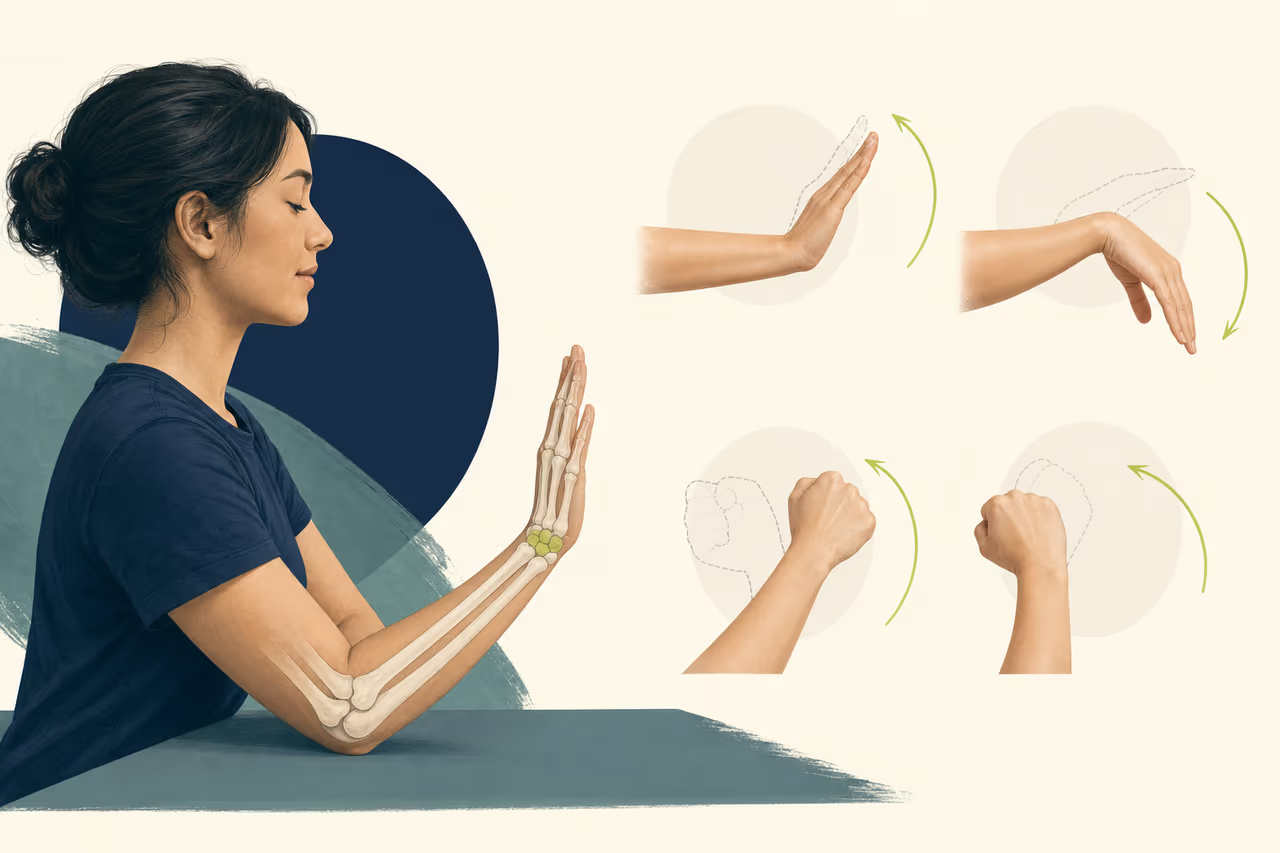
Wrist mobility is the ability to actively control your wrist joint through its full range of motion. It is not simply about how far you can bend your wrist using an external force or gravity; it is about your capacity to move that joint under its own muscular power. In yoga and daily movement, this active control is essential for safely supporting weight, maintaining alignment, and preventing the strain that occurs when you rely on passive end-ranges.
Defining Wrist Mobility
Many people confuse mobility with flexibility, but the two are distinct. Flexibility is a passive measure,it describes the length of the tissues surrounding a joint and how far that joint can be moved by an outside force, such as pushing your hand back with your other hand.
Mobility, by contrast, is active. It requires the strength to stabilize the joint while moving it. If you can push your hand back to a 90-degree angle using your other hand but cannot hold your hand in that position without assistance, you have flexibility, but you lack the mobility to support that position during a weight-bearing pose like a plank or a downward-facing dog.
Why It Matters for Your Practice
In yoga and many other physical activities, the wrists serve as the primary interface between your body and the floor. When you place your hands down to support your weight, your wrists must provide a stable, controlled base.
Muscle strengthening and physical activity are beneficial for all adults, contributing to overall health and functional movement. However, when you perform weight-bearing movements without adequate mobility, you may find yourself "dumping" weight into the joint rather than distributing it through the surrounding musculature. This can lead to discomfort, fatigue, or the feeling that your wrists are a limiting factor in your progress.
Building mobility is a process of consistent, low-intensity effort. It is rarely about achieving a "perfect" range of motion overnight, but rather about developing the consistent strength to manage the positions your practice requires.
Mobility vs. Flexibility: The Trade-offs
Understanding the difference is the first step in avoiding common failure modes, such as attempting high-intensity weight-bearing poses before establishing a baseline of active control.
| Feature | Passive Flexibility | Active Mobility |
|---|---|---|
| Definition | How far a joint can be moved by external force. | How far you can move a joint using your own muscles. |
| Primary Goal | Increasing tissue length. | Increasing control and stability. |
| Yoga Context | Useful for deep, relaxed stretches. | Essential for weight-bearing poses. |
| Risk Factor | Can lead to overstretching if strength is lacking. | Reduces injury risk by ensuring joint stability. |
A common failure mode is ignoring persistent pain in favor of "pushing through" to gain range. If you feel sharp pain, numbness, or tingling, these are signals that your current approach may be exceeding your joint's capacity. Generic online routines cannot account for your unique injury history or anatomical differences. If a movement causes discomfort, it is a sign that you should pause and reassess your approach.
Wrist Mobility Self-Check
Before diving into a new routine, take a moment to reflect on your current baseline. This self-check is not a diagnostic tool, but a way to understand where you are starting from:
- Can you comfortably place your palms flat on the floor with fingers spread wide?
- Do you experience sharp pain or numbness during weight-bearing movements?
- Is your range of motion consistent across both wrists?
- Are you looking for a routine to support a specific goal, like yoga or lifting?
If your range of motion is limited or you experience discomfort during these basic movements, it may be time to move beyond generic videos.
When to Seek Professional Guidance
Generic online routines are a starting point, but they are not a substitute for personalized feedback. If you find that a self-guided routine causes discomfort, fails to produce progress, or if you are unsure how to modify a movement for your specific anatomy, it is time to pivot to a trainer-led session.
Prime Tempr helps readers compare trainers and local movement businesses when a generic mobility routine needs observation, progression, or a format matched to the individual. A professional can assess your specific mechanics, help you identify where you are compensating, and provide a tailored plan that respects your body limits.
Whether you are looking for a Find movement guidance session to refine your technique or simply want to understand how to move more safely, working with a professional ensures that your practice remains sustainable. You can learn more about the nuances of this topic in our guide: Mobility vs Flexibility Explained: What’s the Difference?.
Any amount of physical activity is better than none, and all activity counts. The goal is not to force your body into a shape it is not ready for, but to build the capacity to move comfortably and confidently over the long term.
Sources
Watch alongside this guide
The science of stretch
A Harvard Medical School researcher explains stretching concepts that add useful context to this mobility guide. Source: Conversations That Matter. This optional video is context, not evidence or personal instruction.
The YouTube player stays unloaded until you choose to watch. Loading it connects to YouTube and may allow that service to process usage data.