What to Expect in a Full Body Mobility Class
Learn what a full body mobility class involves, how to scale movements properly, and when to seek expert guidance.
https://primetempr.com/blog/what-to-expect-in-a-full-body-mobility-class
A full body mobility class provides a structured method for improving joint range of motion and control. Unlike passive stretching, which focuses on lengthening muscles, mobility work emphasizes your ability to actively control your joints through their available range. The effectiveness of these classes relies on whether the movements match your current capacity rather than following a generic sequence.
Defining a full body mobility class
Mobility is the combination of flexibility and strength. It is the ability to move a joint through a range of motion under control. In a typical class, you are not just holding a static pose; you are moving through patterns that challenge your muscles to support your joints at the end of their range.
It is helpful to distinguish this work from passive flexibility. If you can push your leg into a high stretch with your hands, that is flexibility. If you can lift your leg to that same height using only your hip muscles, that is mobility. Because any amount of physical activity is better than none, and muscle strengthening benefits everyone, these classes are a vital component of a balanced movement routine.
What to expect in a typical session
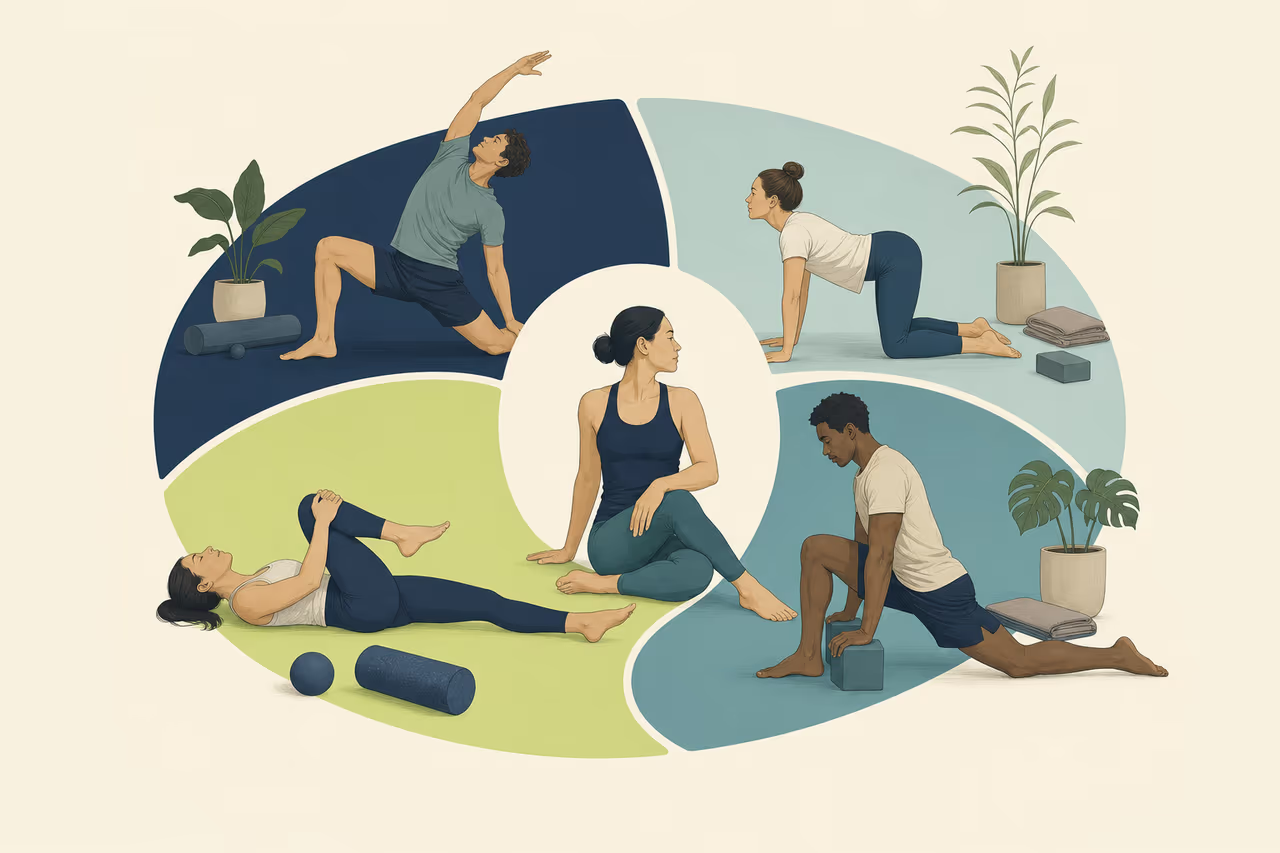
While every instructor has a unique style, most mobility classes follow a logical progression designed to prepare your body for movement. You can generally expect the following components:
- Joint Articulations: Many classes begin with "circles" or rotations of the neck, shoulders, wrists, hips, and ankles. These are often called Controlled Articular Rotations (CARs). The goal is to move each joint through its full available range without compensating with other parts of the body.
- Active Range Work: This involves holding positions that require your muscles to stay engaged. For example, you might perform a lunge while actively squeezing your glutes to stabilize the pelvis.
- Dynamic Flow: Some classes incorporate movement patterns that transition between floor work and standing, encouraging coordination and balance.
- Scaling and Modifications: A well-structured class will offer variations for every movement. If a deep squat is inaccessible, a good instructor will provide a modification, such as using a chair for support or reducing the depth of the movement.
The role of consistency and scaling
It is a common failure mode to assume that mobility work is a "quick fix" for chronic pain or stiffness. Mobility is a practice of maintenance and gradual improvement. Consistency over time is far more important than the intensity of a single session.
According to current physical activity guidelines, adults can work toward 150 to 300 weekly minutes of moderate aerobic activity and muscle strengthening on at least two days. Mobility classes can be integrated into this routine to support your overall capacity. However, if you are following a generic video, you must be prepared to scale the movement to your own level. If a movement feels uncomfortable or impossible, stop immediately. Discomfort is a signal to adjust, not a hurdle to push through.
When to seek personalized guidance
Generic online classes lack the feedback loop of a live trainer. A video cannot see if your form is collapsing or if you are compensating for a restriction by using the wrong muscle group.
If you find that your progress has stalled, or if you are unsure if a specific movement is appropriate for your body, it is time to look for professional support. Prime Tempr helps readers compare trainers and local movement businesses when a generic mobility routine needs observation, progression, or a format matched to the individual. A live trainer can provide the necessary modifications that a recorded video cannot offer.
Choosing Your Mobility Path
To determine if a mobility class is right for you, consider this decision guide:
- Assess your goal: Are you looking for general maintenance, or are you trying to address a specific restriction? If you have a specific injury, consult a medical professional first.
- Check the class format: Is it live, pre-recorded, or a small group setting? Live settings,whether in-person or via virtual video,allow for the trainer to provide feedback.
- Verify the instructor's approach: Do they prioritize active control over passive stretching? Do they offer clear modifications for different ability levels?
- Start small: Commit to one session and observe how your body feels the next day. If you feel sharp pain, the intensity or the movement selection was likely too high for your current level.
- Seek feedback: If you feel stuck, use Find movement guidance to find a local trainer for a one-on-one assessment.
Common Questions
Do I need special equipment? Most mobility classes require very little equipment. A yoga mat is usually sufficient. Some instructors may use blocks, straps, or light resistance bands, but these are often optional or can be replaced with household items.
How is mobility different from flexibility? For a deeper dive into this, see Mobility vs Flexibility Explained: What’s the Difference?. In short, flexibility is passive, while mobility requires active muscle engagement.
What if a movement causes pain? If a movement causes sharp or persistent pain, stop immediately. Use the discomfort as a signal to seek a trainer who can provide personalized modifications or assess if a different type of movement is more appropriate for your current state. Mobility classes are not a substitute for medical treatment for injuries.
Sources
- Physical activity (opens in a new tab), World Health Organization.
- Top 10 Things to Know About the Physical Activity Guidelines (opens in a new tab), Office of Disease Prevention and Health Promotion.
Watch alongside this guide
The science of stretch
A Harvard Medical School researcher explains stretching concepts that add useful context to this mobility guide. Source: Conversations That Matter. This optional video is context, not evidence or personal instruction.
The YouTube player stays unloaded until you choose to watch. Loading it connects to YouTube and may allow that service to process usage data.