What Calf Mobility Means: A Practical Guide
Learn how active ankle control differs from passive stretching, why functional movement matters, and when to seek professional guidance.
https://primetempr.com/blog/what-calf-mobility-means-a-practical-guide
Calf mobility is the ability to actively control the range of motion around your ankle joint. It is fundamentally different from passive flexibility, which simply measures how far a muscle can stretch. When you work on calf mobility, you train your body to use its full range of motion under control, rather than just relaxing into a position.
Many people confuse the two, often spending time in static stretches hoping for long-term functional changes. While stretching has its place, mobility requires active engagement, which is essential for how we move in the real world.
Defining Calf Mobility vs. Flexibility
The most common failure mode in movement training is assuming that stretching is the same as mobility. Flexibility is a passive state. It is the measure of how much your tissues can lengthen when an external force, like gravity or your own hands, is applied.
Calf mobility, by contrast, is active. It is the strength and coordination required to move your ankle through its available range of motion without assistance.
| Feature | Passive Flexibility | Active Mobility |
|---|---|---|
| Primary Driver | External force (gravity, straps) | Internal force (muscle contraction) |
| Focus | Tissue length | Joint control and strength |
| Application | Relaxation, recovery | Functional movement, performance |
If you can pull your toes toward your shin with your hands, you have flexibility. If you can lift your toes toward your shin using only your own muscles, you have mobility. Both are useful, but they serve different purposes in your overall movement health.
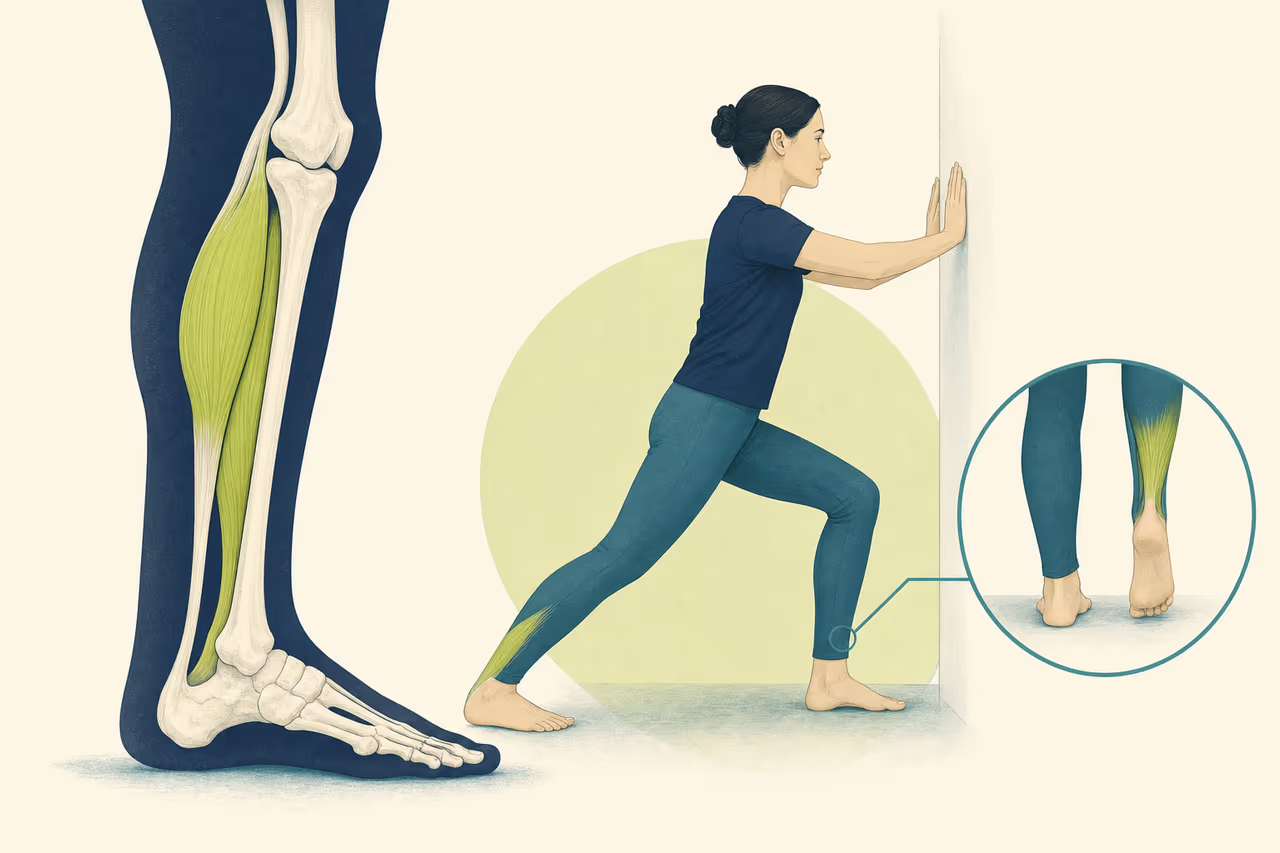
Why Mobility Matters for Everyday Movement
Your calves play a critical role in how you walk, squat, and balance. Every time you take a step, your ankle must dorsiflex, moving your toes toward your shin, to allow your body to move over your foot. If your mobility is limited, your body often compensates by changing your gait or putting extra stress on the knee or hip.
Physical activity and muscle strengthening are beneficial for all adults, contributing to overall functional health. According to the Physical Activity Guidelines, adults should aim for 150 to 300 minutes of moderate aerobic activity and muscle strengthening on at least two days per week. When your calf mobility is sufficient, you are better equipped to perform these strengthening exercises,like calf raises or squats,with proper form and less risk of compensation.
However, Be sure to be realistic. Mobility work is not a "quick fix" for chronic pain or structural issues. If you are experiencing persistent discomfort, mobility drills are not a substitute for medical evaluation. Individual anatomy,such as the shape of your ankle bones,can influence your range of motion more than any generic drill ever will.
Assessing Your Next Step
If you have been following a generic mobility routine and feel like you are not seeing progress, or if you feel unsure about your technique, you may need more than a pre-recorded video or a static list of stretches.
Prime Tempr helps readers compare trainers and local movement businesses when a generic mobility routine needs observation, progression, or a format matched to the individual. A qualified trainer can help you determine if your restrictions stem from a lack of strength, a need for better coordination, or simply your unique anatomical baseline.
Reflection: Assessing Your Next Step
Use this checklist to determine how to move forward with your practice:
- Observe your comfort: Pay attention to how your ankles feel during daily activities like walking up stairs or performing a basic squat. Do you feel "stuck" or restricted?
- Identify your current approach: Are you mostly performing passive stretches (holding a position for 30+ seconds), or are you incorporating active mobility (moving through a range with control)?
- Evaluate your goals: Is your current routine helping you move with more ease, or are you just checking a box?
- Consider professional support: If your progress has plateaued or you are worried about your form, it is time to find movement guidance. A trainer can provide the observation and personalized progression that generic routines lack.
When to Seek Professional Guidance
Mobility work is a trade-off. It requires consistent, active effort rather than passive holding. Because every body is different, what works for one person may not work for another.
You should consider seeking professional guidance if you have attempted self-guided mobility work for several weeks without feeling a change in your functional movement, if you feel pain rather than just a stretch during your movements, if you are unsure if your current exercises are appropriate for your specific goals or history, or if you want to progress beyond basic maintenance into more advanced strength or movement patterns.
Professional guidance allows you to move safely and effectively, ensuring that your time spent on the mat or in the gym actually translates to better movement in your daily life. For more on the nuance of these concepts, see our guide on Mobility vs Flexibility Explained: What’s the Difference?.
Sources
- Physical activity (opens in a new tab), World Health Organization.
- Top 10 Things to Know About the Physical Activity Guidelines (opens in a new tab), Office of Disease Prevention and Health Promotion.
Watch alongside this guide
The science of stretch
A Harvard Medical School researcher explains stretching concepts that add useful context to this mobility guide. Source: Conversations That Matter. This optional video is context, not evidence or personal instruction.
The YouTube player stays unloaded until you choose to watch. Loading it connects to YouTube and may allow that service to process usage data.