Shoulder Mobility Terminology Explained: Clear Definitions for Everyday Movement
Understand shoulder mobility, flexibility, and stability, and know when expert guidance can help.
https://primetempr.com/blog/shoulder-mobility-terminology-explained-clear-definitions-fo
Understanding common shoulder movement terms helps adults make practical choices between self-guided practice and professional instruction without relying on confusing jargon. Fitness media often treats terms like flexibility, mobility, and stability as interchangeable, leaving practitioners wondering why a generic stretch routine feels stiff or ineffective. Clear definitions and structured physical activity goals make it easier to navigate these choices safely.
Plain-Language Definitions for Shoulder Movement
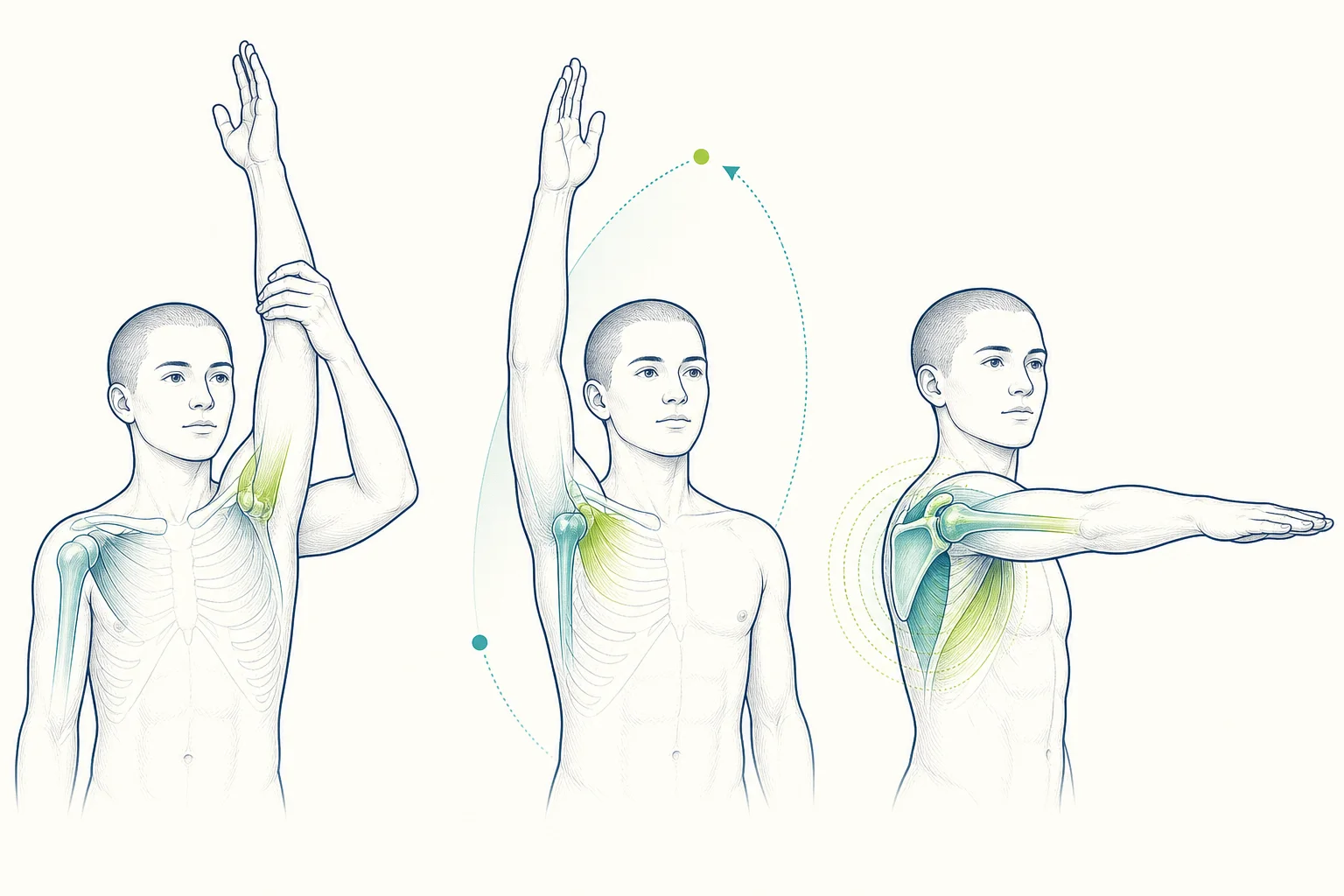
The primary confusion in shoulder movement education stems from mixing passive ranges with active control. To understand how your upper body moves, it helps to separate these concepts:
- Flexibility: The ability of soft tissues (muscles and tendons) to lengthen passively. It measures how far a joint can move when an outside force,such as gravity, a strap, or the opposite hand,assists the movement.
- Mobility: The ability to move a joint actively through an intended range of motion using your own muscular control and joint health.
- Stability: The capacity of the surrounding muscles and ligaments to keep the joint secure and aligned while movement occurs.
Treating flexibility and mobility as interchangeable terms is a common failure mode. A person might possess passive flexibility to lift an arm overhead with assistance, yet lack the active mobility and stability to control that path independently. Chasing high-intensity stretches or deep ranges at the expense of controlled joint movement often leads to frustration rather than progress. When generic stretches or routines feel stiff or ineffective, stepping back to comfortable, pain-free ranges of motion is an essential recovery path.
| Term | Primary Focus | Example in Daily Practice | Common Limitation |
|---|---|---|---|
| Flexibility | Passive tissue length | Holding a seated forward fold with a strap | Passive range does not equal active control |
| Mobility | Active joint control | Lifting and rotating the arm smoothly without assistance | Requires muscular engagement and coordination |
| Stability | Joint security and alignment | Maintaining a steady shoulder girdle during a plank | Can break down under excessive load or fatigue |
For a deeper look at these foundational concepts, explore our guide on Mobility vs Flexibility Explained: What’s the Difference? or browse related topics under Mobility & Flexibility.
How Physical Activity Guidelines Support Joint Health
Structured movement requires a baseline of general physical activity to support overall joint and muscle function. Public health frameworks provide helpful boundaries for weekly habits without requiring extreme intensity. According to institutional guidelines, any amount of physical activity is better than none, and all activity counts.
Adults can work toward 150 to 300 weekly minutes of moderate aerobic activity, such as brisk walking, swimming, or cycling. Alongside aerobic movement, adults can work toward muscle strengthening on at least two days per week. Muscle strengthening benefits everyone, helping to support the stability required for healthy shoulder movement during daily tasks and yoga postures alike.
Relying entirely on a generic online routine can create blind spots, especially if an individual assumes a single template fits all body types. General frameworks work best when adapted to personal capacity rather than forced into a rigid schedule.
When to Move Beyond Self-Guided Routines
Self-guided practice is accessible and flexible, but it lacks real-time feedback on form and joint control. When a generic video or template stops delivering results or leaves your shoulders feeling restricted, it may be time to seek external perspective.
Working with a trainer provides tailored progression, but requires scheduling and financial investment. If you find yourself wondering whether an online sequence is serving your body, Prime Tempr helps readers compare trainers and local movement businesses when a generic mobility routine needs observation, progression or a format matched to the individual. You can easily Find movement guidance to connect with local professionals who offer direct feedback.
Shoulder Movement Terms Quick Check
Use this checklist to evaluate your current movement habits and decide on your next step:
- Distinguish between passive flexibility and active mobility in daily movement.
- Confirm that your routine includes muscle-strengthening activity on at least two days per week.
- Check that you are working within comfortable, pain-free ranges of motion.
- Consider whether a trainer or local movement class could offer helpful observation and progression.
Sources
- Physical activity, World Health Organization (WHO): https://www.who.int/news-room/fact-sheets/detail/physical-activity (opens in a new tab)
- Top 10 Things to Know About the Physical Activity Guidelines, Office of Disease Prevention and Health Promotion (ODPHP): https://odphp.health.gov/our-work/nutrition-physical-activity/physical-activity-guidelines/current-guidelines/top-10-things-know (opens in a new tab)
Watch alongside this guide
The science of stretch
A Harvard Medical School researcher explains stretching concepts that add useful context to this mobility guide. Source: Conversations That Matter. This optional video is context, not evidence or personal instruction.
The YouTube player stays unloaded until you choose to watch. Loading it connects to YouTube and may allow that service to process usage data.