Mobility Before vs. After a Workout: A Practical Guide
Compare mobility before vs. after a workout and choose what fits your practice.
https://primetempr.com/blog/mobility-before-vs-after-a-workout-a-practical-guide
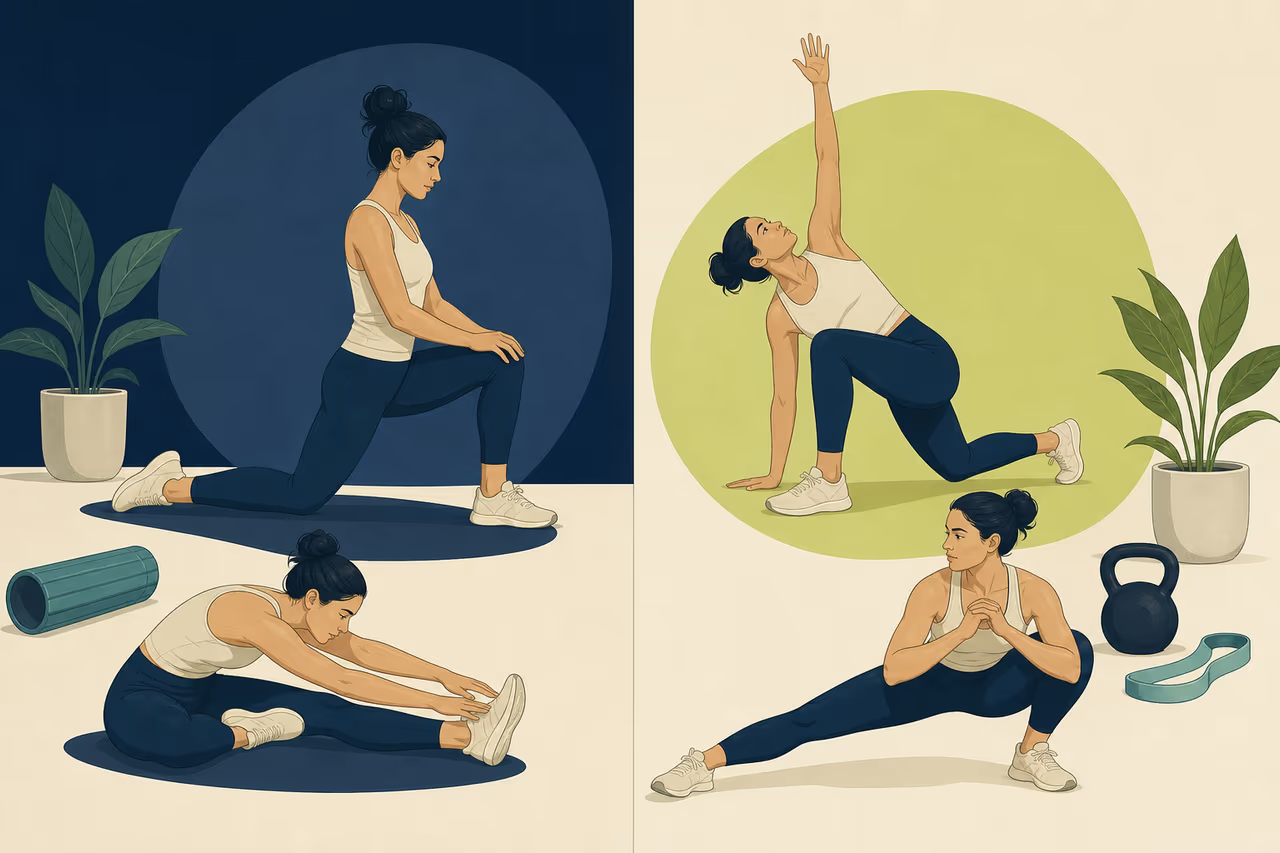
Mobility work is not a binary choice between before or after a workout; it is a tool for preparation or recovery, and the best approach depends on your specific movement goals and how your body responds to each. You do not need to choose one over the other, nor are you required to perform both to see benefits. Because any amount of physical activity is better than none, the most effective timing is the one that allows you to remain consistent and move with higher quality.
The Goal of Pre-Workout Mobility
The primary goal of pre-workout mobility is to prepare your joints and nervous system for the specific movement patterns you are about to perform. Think of it as a "check-in" rather than a deep, passive stretch.
When you perform mobility work before a workout, you are aiming to:
- Increase joint range of motion: Gently moving through your functional range helps "unlock" the movement patterns required for your session, such as squatting, reaching, or rotating.
- Improve movement quality: By waking up the muscles and lubricating the joints, you can often perform your primary exercise with better form.
- Prepare the nervous system: Dynamic movements signal to your body that it is time to transition from a sedentary state to an active one.
The trade-off here is time. If you have a limited window for your workout, spending 20 minutes on mobility may leave you with less time for your main activity. If you are short on time, prioritize movement quality during the workout itself rather than forcing a long, generic pre-workout routine.
The Role of Post-Workout Mobility
Post-workout mobility serves a different purpose: down-regulation and recovery. After the intensity of a workout, your nervous system is often in an "up" state. Mobility work at this time can help shift your body toward a parasympathetic (rest and digest) state.
When you perform mobility work after a workout, you are aiming to:
- Explore end-range comfort: Because your muscles are warm and pliable, you may find it easier to explore deeper ranges of motion without the pressure of needing to perform explosive movements.
- Down-regulate: Slow, controlled mobility work combined with intentional breathing can help lower your heart rate and signal to your body that the stress of the workout is over.
- Address stiffness: If you notice specific areas feel tight or restricted following a session, gentle movement can help mitigate the feeling of "locking up" after activity.
The primary failure mode here is fatigue. After a challenging session, it is common to skip post-workout mobility entirely. If you find yourself consistently skipping this phase, consider moving your mobility work to a separate time of day or shortening it to just two or three essential movements.
Can I Do Mobility Work at Both Times?
Yes, you can incorporate mobility work at both times, provided the intent of each session is clear. The key is to keep the pre-workout portion dynamic and focused on preparation, while keeping the post-workout portion slower and focused on recovery.
However, avoid the trap of over-complicating your routine. If you spend more time managing a complex list of exercises than you do actually moving, you are likely to lose consistency. Remember that all activity counts toward health benefits, and a simple, consistent routine will almost always outperform a complex, irregular one.
Why Personalization Matters
A common failure mode is treating mobility as a "fix" for pain or as a generic checklist. If you are following a video or an app and you still feel restricted, or if you are unsure if your form is actually helping, you may have reached the limit of self-guided practice.
Generic online routines cannot see your specific movement patterns or understand how your body responds to certain loads. This is where Prime Tempr helps. Prime Tempr helps readers compare trainers and local movement businesses when a generic mobility routine needs observation, progression or a format matched to the individual.
If you feel stuck or unsure of your form, booking a session with a local trainer can provide the objective feedback needed to refine your approach. A trainer can help you identify whether your "tightness" is a lack of flexibility, a lack of strength, or simply a movement pattern that needs adjustment.
Choosing Your Mobility Timing
| Goal | Recommended Timing | Focus |
|---|---|---|
| Preparation | Pre-workout | Dynamic, joint-specific, movement-focused |
| Recovery | Post-workout | Slow, controlled, end-range exploration |
| Consistency | Whenever possible | Simplicity and habit formation |
Action Artifact: Choosing Your Mobility Timing
- Use pre-workout mobility to prepare joints for specific movement patterns you plan to perform.
- Use post-workout mobility to down-regulate your nervous system and explore end-range comfort.
- If you are short on time, prioritize movement quality during the workout itself rather than forcing a long, generic pre-workout routine.
- If you feel stuck or unsure of your form, book a session with a local trainer to get eyes on your movement patterns.
If you are ready to move beyond generic advice, Find movement guidance to connect with professionals who can tailor a routine to your specific needs. For more on the fundamentals, see our guide: Mobility vs Flexibility Explained: What’s the Difference?.
Sources
- Physical activity (opens in a new tab), World Health Organization.
- Top 10 Things to Know About the Physical Activity Guidelines (opens in a new tab), Office of Disease Prevention and Health Promotion.
Watch alongside this guide
The science of stretch
A Harvard Medical School researcher explains stretching concepts that add useful context to this mobility guide. Source: Conversations That Matter. This optional video is context, not evidence or personal instruction.
The YouTube player stays unloaded until you choose to watch. Loading it connects to YouTube and may allow that service to process usage data.