What Joint Range of Motion Actually Means (and What It Doesn't)
Learn what joint range of motion means, its practical limits and trade-offs, and how to choose one realistic next step.
https://primetempr.com/blog/what-joint-range-of-motion-actually-means-and-what-it-doesn-
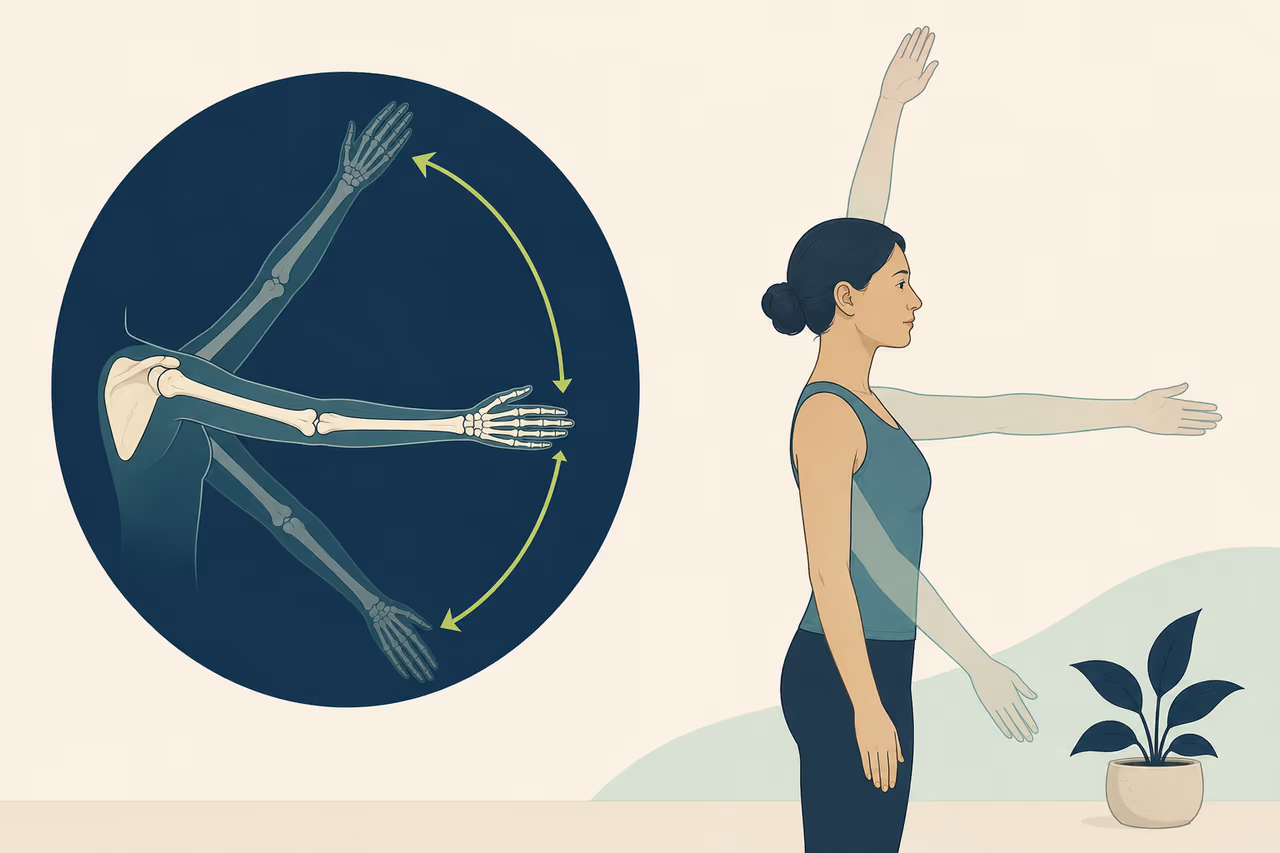
Joint range of motion measures the full operational arc through which a specific joint can move, encompassing both the anatomical structure of the joint and the nervous system's willingness to allow movement along that path.
Readers often confuse passive flexibility with active joint control and lack a clear, non-judgmental way to understand their own movement limits. This guide explains what range of motion represents, why strength and steady activity matter just as much as stretching, and how to evaluate whether a generic mobility video helps your body or if you need individual feedback.
Defining joint range of motion
Joint range of motion describes the angular distance a joint travels from its starting position to its limit in a given direction. Every joint in the human body, from the hinge of the knee to the ball-and-socket configuration of the hip and shoulder, has a theoretical maximum path governed by bone shape, joint capsules, ligaments, tendons, and surrounding musculature.
Range of motion is not a static score or a moral grade. It fluctuates based on hydration, temperature, sleep, recent physical activity, and stress. A common misconception is that more range is always better. In reality, a joint requires both the capacity to move through an arc and the muscular control to stabilize itself at the end of that arc. Passive flexibility, such as letting gravity pull your torso down toward your toes, simply shows how far tissues can lengthen under external force. Active range of motion relies on your own muscles to drive and control the movement.
Range of motion versus physical activity and strength
Focusing exclusively on stretching a tight hamstring or opening a stiff hip misses the broader picture of physical health. Movement requires a foundation of general physical conditioning and muscular support.
Institutional health standards emphasize that any amount of physical activity is better than none, all activity counts, and muscle strengthening benefits everyone. Public health guidelines advise that adults can work toward 150 to 300 weekly minutes of moderate aerobic activity and muscle strengthening on at least two days.
| Metric or Concept | What It Measures | Typical Limitation |
|---|---|---|
| Passive Flexibility | How far tissues lengthen under external force or gravity | Does not reflect active muscular control or joint stability |
| Active Range of Motion | How far you can move a joint using your own muscle power | Can be restricted by temporary fatigue, muscle tension, or guarding |
| Muscle Strengthening | Force-generating capacity of skeletal muscles | Often neglected in favor of endless passive stretching |
When you build muscle strength alongside regular movement, you give your joints the armor and control they need to navigate everyday life safely. Relying solely on passive stretching without strengthening the supporting musculature often leaves joints feeling vulnerable or chronically tight as the body attempts to protect itself from instability.
Recognizing your limits and trade-offs
Trying to force a joint past its current comfort point through aggressive stretching is a frequent failure mode. Assuming that stretching harder automatically fixes joint limitations often leads to irritation or regression, because the nervous system responds to abrupt force by tightening surrounding muscles.
It helps to acknowledge the trade-offs inherent in how we train.
- Generic routines are accessible, free, and easy to fit into a busy schedule, but they cannot account for individual skeletal variations, previous injuries, or unique tissue restrictions.
- Working with a local trainer offers personalized observation, real-time feedback, and customized progression, but it requires an investment of time and financial resources.
Accepting these trade-offs removes the guilt from choosing a simple online video on some days while recognizing the value of professional eyes on others.
Choosing your next step
If your current movement routine feels repetitive or if a particular stiffness persists despite regular stretching, you do not need an immediate overhaul. Start by observing how your body responds to baseline activity, ensure your week includes a balance of general movement and basic strengthening, and consider whether an outside perspective would help clarify your movement patterns.
Prime Tempr helps readers compare trainers and local movement businesses when a generic mobility routine needs observation, progression, or a format matched to the individual. Whether you prefer exploring self-guided classes or connecting with a local studio, matching your approach to your actual physical context is the most sustainable path forward.
Joint Range & Movement Check-In
- Note any daily activities where joints feel stiff or limited without forcing the movement.
- Verify your weekly routine includes both regular physical activity and muscle strengthening.
- Determine if self-guided practice is meeting your needs or if an observed session would help.
Explore options on our Mobility & Flexibility hub, or find movement guidance and find yoga near you to connect with local professionals.
Sources
- Physical activity (opens in a new tab), World Health Organization
- Top 10 Things to Know About the Physical Activity Guidelines (opens in a new tab), Office of Disease Prevention and Health Promotion
Watch alongside this guide
The science of stretch
A Harvard Medical School researcher explains stretching concepts that add useful context to this mobility guide. Source: Conversations That Matter. This optional video is context, not evidence or personal instruction.
The YouTube player stays unloaded until you choose to watch. Loading it connects to YouTube and may allow that service to process usage data.